Spotted Seatrout vs. weakfish: how to tell them apart
Two Cynoscion cousins on opposite coasts. Spot pattern and range usually settle the call.
Fast comparison
| Feature | Spotted Seatrout | Weakfish |
|---|---|---|
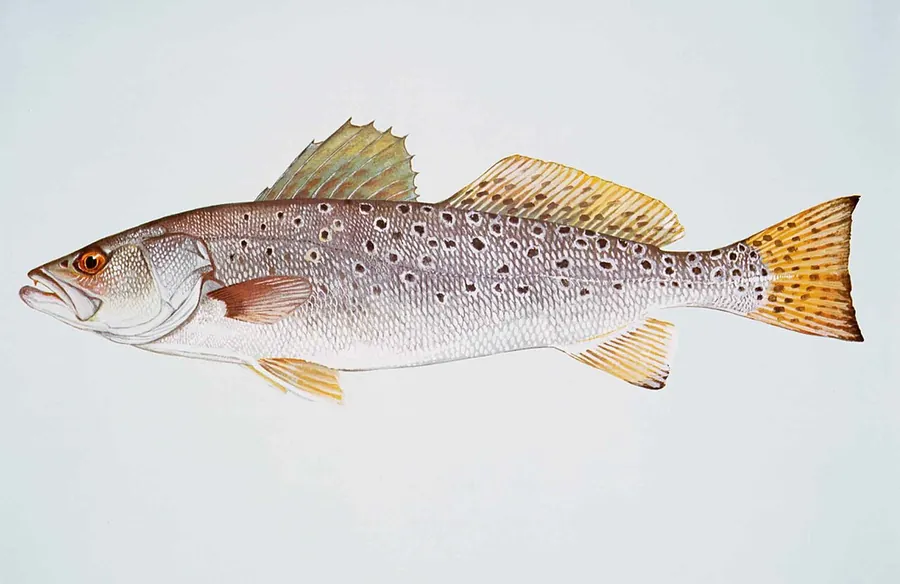
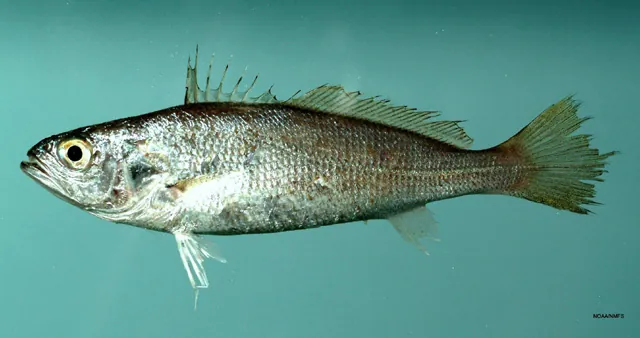
| Spot pattern | Distinct round black spots across back, dorsal and tail | Few, small, irregular spots — more vermiculation than dots |
| Anal-fin spines | One thin spine | Two thin spines |
| Back color | Blue-gray to green with silver flanks | Bronze-green to olive with purple sheen |
| Range | Gulf of Mexico and US Southeast coasts | Mid-Atlantic to Northeast coasts |
Photograph these features
- Flank and dorsal in even light for spot pattern
- Anal fin region to count spines
- Tail spread — trout spots cross the fin
- Location noted: the coasts barely overlap
When it is not clear-cut
Where ranges meet (VirginiaCarolinas), a spotless or oddly spotted fish can challenge both names. The anal-spine count is the published tiebreaker.
Identification tools can be wrong. Confirm uncertain fish with the local fisheries authority before relying on the result for harvest or possession rules.
Compare your catch
Use an AI-assisted suggestion as a starting point, then check the features above yourself.
Upload a fish photoBrowse speciesSpotted Seatrout species guide
Full profile: habitat, baits, seasons and range.
Weakfish species guide
Full profile: habitat, baits, seasons and range.
Frequently asked questions
- Why "weak"fish?
- Named for the weak mouth membrane that tears on hooks — handle gently.
- Are they related to freshwater trout?
- No — both are drum family (Sciaenidae); the "trout" name is purely colloquial.
- Which is better to eat?
- Both are delicate; smaller fish of either species eat best.
Authoritative references
Cynoscion nebulosus — Wikipedia
Cynoscion regalis — Wikipedia