King Mackerel vs. spanish mackerel: how to tell them apart
The speed family. Size and the lateral-line "drop" separate kings from spaniards.
Fast comparison
| Feature | King Mackerel | Spanish Mackerel |
|---|---|---|
| Size | Commonly 10–40 lb; giants past 60 lb | 1–5 lb; rarely past 10 lb |
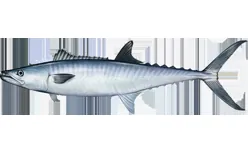
| Lateral line | Dips sharply below the second dorsal fin | Gently slopes the full length |
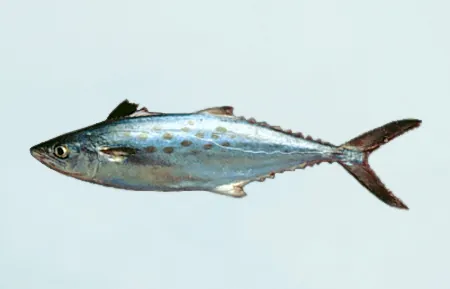
| Spots | Usually spotless; juveniles can show spots | Bronze oval spots on the flank |
| Dorsal fin | Gray front edge | Distinctly black front edge on the first dorsal |
Photograph these features
- Lateral line trace from gill plate to tail
- First dorsal fin edge color
- Flank for spots
- Girth photo — size gap is the quickest tell
When it is not clear-cut
Small "school" kings muddy the waters: they can carry spots like spanish. The lateral-line dip is the published separator — trace it in the photo.
Identification tools can be wrong. Confirm uncertain fish with the local fisheries authority before relying on the result for harvest or possession rules.
Compare your catch
Use an AI-assisted suggestion as a starting point, then check the features above yourself.
Upload a fish photoBrowse speciesKing Mackerel species guide
Full profile: habitat, baits, seasons and range.
Spanish Mackerel species guide
Full profile: habitat, baits, seasons and range.
Frequently asked questions
- Which is better eating?
- Small spanish are clean and mild; kings are favored for smoking and steaks.
- Which is the tournament fish?
- King mackerel — the SKA circuit is built around them.
- Both bite the same tackle?
- Similar trolled spoons and live bait; kings demand wire leaders.
Authoritative references
Scomberomorus cavalla — Wikipedia
Scomberomorus maculatus — Wikipedia